
There are also concerns that the region will be so focused on revitalizing renewable energy that it will neglect the nuclear industry.
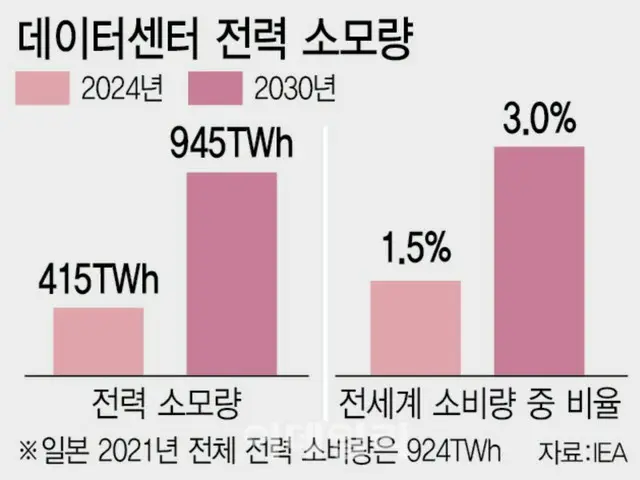
According to the Korea Electric Power Exchange on the 11th, the total power consumption of AI data centers in Korea in 2023 will be about 13.5 TWh (terawatt hours),
This is equivalent to the annual electricity consumption of the entire city of Ulsan in South Korea. Due to the increase in demand for AI generation, it is expected to surge by more than 50% annually until 2030, but the expansion of South Korea's electricity infrastructure is insufficient.
The situation is satisfactory. According to a report titled "Measures to alleviate the concentration of data centers in the capital area" released by the Ministry of Trade, Industry and Energy, the demand for new data centers alone by 2029 is expected to reach 732 locations.
The contracted power capacity (power that Korea Electric Power Corporation is obligated to supply to customers) will reach 49,397MW. This capacity is 5 times the maximum national contracted power (94,509MW) recorded in 2022.
This equates to 2% of the total electricity used by the entire country in a year, meaning that data centers would have to supply almost half of the electricity used by the entire country in a year.
In this way, AI is called "electricity-eating hippopotamus" in Korea.
To operate 260,000 GPUs, which have been prioritized for supply to the country, requires 1 GW (gigawatt) of electricity, which is equivalent to the capacity of one nuclear power plant.
Just in the US, running a data center for training requires approximately 1.3 GWh of electricity, equivalent to the amount of electricity used by 100,000 homes in a day.
According to the International Energy Agency (IEA), nuclear power capacity will fall from 417 GW to 205 GW in 2022 due to a surge in electricity demand caused by AI.
This is expected to more than double to 916 GW by 2020. As a result, major competing countries around the world are stepping up their efforts to secure power sources for new growth industries such as AI, next-generation semiconductors, and electric vehicles.
It has been pointed out that South Korea, which prioritizes renewable energy sources such as solar and wind power, is the only country that is out of step with the global trend.
Minister of Energy and Environment Hou recently mentioned holding a public debate on the two new nuclear power plants, but there are criticisms that he is using the public debate as an excuse to scrap the nuclear power plant construction.
Professor Cho Hong-jeong of the Department of Economics at Dankook University said, "Countries around the world are restarting nuclear power plants that have been shut down and building new nuclear power plants in order to achieve AX (AI transformation).
"We are also increasing nuclear power generation," he said, explaining, "Nuclear power is important in that it is a base power source that maintains a stable domestic power supply."
2025/12/11 21:31 KST
Copyrights(C) Edaily wowkorea.jp 78