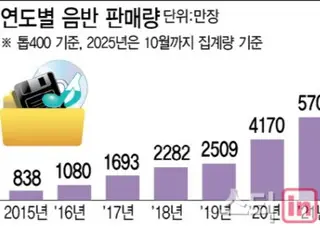

[The end of the era of concentrated fan power... Growth slows] According to the Korea Music Content Association on the 10th,
The cumulative sales of albums up to October (based on the Top 400) was calculated to be approximately 80.5 million copies. This is a decrease of approximately 810,000 copies compared to a year ago. At the current rate, the annual sales volume for this year is expected to reach 90 million copies.
The K-POP album market is expected to grow explosively during the coronavirus pandemic as fans focus their spending on albums, reaching a record-breaking annual sales of 100 million units by 2023.
However, the following year, album sales fell by about 19.4% to just 93 million copies, and the same is true this year.
Some analysts say that this is due to fans' competitive purchasing fervor cooling down and growing fatigue with the sales method linked to the fans autographing session application ticket.
Export indicators are also declining. According to the Korea Customs Service, the value of music exports through October this year was $243.84 million (approximately 358.3 billion won/approximately 358.8 billion yen).
100 billion won), a 2.7% decrease compared to the same period last year. In particular, the Japanese market, the largest export destination, saw its exports decrease from $79.23 million (approximately 116.4 billion won/approximately 11.6 billion yen) to $70.45 million (approximately 103.5 billion won/approximately 11.6 billion yen).
It is noticeable that the figure has dropped by 11.1% to approximately 10.3 billion yen. Analysis shows that the competitiveness of Japanese idol groups has increased and the size of K-POP fans has weakened.
Exports to the US and China, which are major markets, also fell by 5.9% and 6.5%, respectively. Polarization between large entertainment agencies and small and medium-sized agencies is also worsening.
The number of groups under the agency has dwindled to the point that they can be counted on one hand. While production costs for essential content such as music videos and dance productions and labor costs for K-POP specialists are rising, album sales are declining.
An increasing number of agencies are complaining about the burden of operating the system. [Dwindling K-Pop Ecosystem Shaking the Recording Market] There are concerns in the industry that the stagnation of the recording market will hinder the sustainable growth of K-Pop.
An industry insider said, "If the slump in the music industry continues for a long time, the number of active teams will gradually decrease, and the diversity of genres and concepts may disappear."
There is also growing concern about how to increase the value of albums, which are more of a merchandise than a music product.
Some are calling for a new album policy that meets fans' expectations, such as a digital photobook-linked album. One music agency CEO said, "Even in the age of streaming, albums are a symbol of fan solidarity.
"The fact that they are still important will not change," he said, but emphasized that "creating content that has value will become even more important."
The anticipation factor of their comeback remains. With BTS teasing the release of a new album in the first half of next year, attention is focused on whether their activities will spark a market rebound.
Kim Jin Woo, a music data journalist, said, "BTS has recorded an average of over 7 million album sales every year," and "Even mid-level groups have a high level of popularity."
"We can also expect a positive impact from this," he said. "Exports will also recover as the team is able to rebound simultaneously in the three major markets of Japan, the US, and China."
2025/12/11 07:00 KST
Copyrights(C) Edaily wowkorea.jp 71