
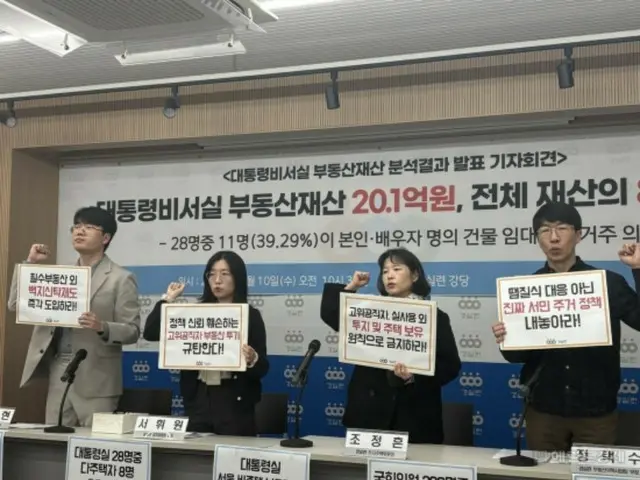
Criticism that the personal property policy is preventing ordinary people and young people from entering the market is expected to grow. The Citizens' Alliance for Economic Justice (CIE) held a press conference at the CIE auditorium in Jongno-gu, Seoul on the 10th.
The average reported real estate assets of each of the 28 members of the presidential office is 2.03 billion won (approximately 216 million yen), which is 4.87 times the national average of 420 million won (approximately 44.6 million yen).
According to the analysis by the Korea Economic and Social Security Association, among the 28 high-ranking officials in the presidential office whose assets were disclosed this year, the average amount declared per person by the top five in real estate assets based on direct lineage ascendants and descendants was 54,000.
The total amount was reported to be 200 million won. Kim Sang-ho, Secretary for Press Support, Lee Tae-hyeong, Secretary for Civil Affairs, Moon Jin-young, Senior Secretary for Social Affairs, Choi Seong-ah, Secretary for Overseas Press, and Kang Yu
This includes Press Secretary John. Their current home ownership status was also far from the national average. Of the 28 people, 23 owned their own homes. Of these, 23 were multi-homeowners, meaning they owned more than one home.
There were 8 people who reported their residences under their own or their spouse's name, accounting for approximately 30% of the total. Of these, 21, or more than half, were in Seoul, and 15 of these were in the three Gangnam districts (Gangnam, Seocho,
The Korea Federation of Economic and Social Security Administration (KFEA) said, "The analysis of real estate assets of National Assembly members released last month showed that the average real estate assets per member of the National Assembly is 1.95 billion won, and the ratio of those with multiple homes is 1.95 billion won."
"The asset structure of the core staff who design and implement the housing price stabilization policy is far removed from the reality of the people," he said.
In addition, there were many "rented" homes that the owners did not live in. Of the 23 homeowners, 7 were renting out their homes through Jeonse (a system in which a large deposit is received for rent).
It was also revealed that of the nine people who own homes in the three districts of Gangnam, two are renting them using Jeonse. The proportion of people who own non-residential buildings was also high. Of the 28 presidential office holders, 11 (3
9.3%) owned 15 non-residential buildings such as shops, neighborhood facilities, and offices in their own or their spouse's name. Of these, 7 buildings were concentrated in Seoul.
The average declared amount was 1.08 billion won. The discrepancy between the reported amount and the current market value of the apartments was also revealed. Of the 25 apartments owned by presidential office holders, only one has the right to sell and the current market value is unknown.
After investigating 23 buildings, excluding one that was in difficulty, the average declared value was 1.21 billion won, but the market value as of November 2025 was found to be 1.83 billion won.
The amount was 620 million won lower than the actual market value, resulting in a market value reflection rate of only 66%. Looking at individual apartments, the Acro River Park in Banpo-dong, Seocho-gu, Seoul, owned by Kang,
The current market value of the apartment was 6.25 billion won, the highest. This was followed by the Woosung Apartment in Jamsil-dong, Songpa-gu (4.2 billion won) owned by Lee Seung-il, Secretary for Civil Affairs, and the Han Apartment in Ichon-dong, Yongsan-gu owned by Senior Secretary for Culture and Social Affairs.
Garam Apartment (3.1 billion won) and Seocho Raemian (2.85 billion won) were next. In the case of Acro River Park, the difference between the declared amount and the market value was 2.693 billion won.
All of the top five apartments showed a large difference between their market value and their reported value. Seo Hee-won, head of the Korean Federation of Economic and Social Security Political and Legislative Team, said on the same day, "The average housing price in Seoul is 1.24 billion won.
"The fact that the average real estate assets of the presidential office exceed 2 billion won shows that the people who design policies are not in sync with the common people and young people," he said.
"While capital controls prevent people from entering the market, a repeating pattern has been created in which public officials increase their assets by owning or renting multiple homes in Gangnam," he said.
Jeong Taek-soo, deputy director of the Korea Federation of Economic and Social Security Administration's real estate national policy project team, said, "In 2003, it was possible to do it for 300 million won.
"A 30-pyeong apartment building that was once priced at 100 million won now costs about 1.3 billion won. In the same period, the price in Gangnam District 3 jumped from 500 million won to 3.2 billion won," he said. "A single apartment building in Gangnam can cost billions of won.
"Even though the won is appreciating, public officials own many apartments in expensive areas like this," he said.
He continued, "The average declared value of the 23 apartment buildings is 1.19 billion won, but the actual market value is
"The assets of lawmakers and senior officials in the presidential office exceed 1.8 billion won," he said, adding, "The asset reporting system itself needs to be reviewed."
The concentration of people in the Gangnam and Han River belts is a phenomenon that indicates the breakdown of social trust. "The average person with an average asset of 400 million won has no idea that a 1.5 billion won apartment in Gangnam is an ordinary home.
"The asset disclosure system has been in place for 30 years, but it is not effective enough," he said. "The ban on buying and selling real estate that the individual does not live in, the establishment of blank trusts, and the forced sale of real estate should be implemented.
"We need strong measures to prevent conflicts of interest, such as a compensation system," he emphasized.
2025/12/11 06:58 KST
Copyrights(C) Herald wowkorea.jp 104