
The Korea Business Association announced on the 9th that it conducted a survey of 2,492 students and graduates (including those who are scheduled to repeat a year or graduate) of four-year universities nationwide, titled "2025 University Student Employment Awareness."
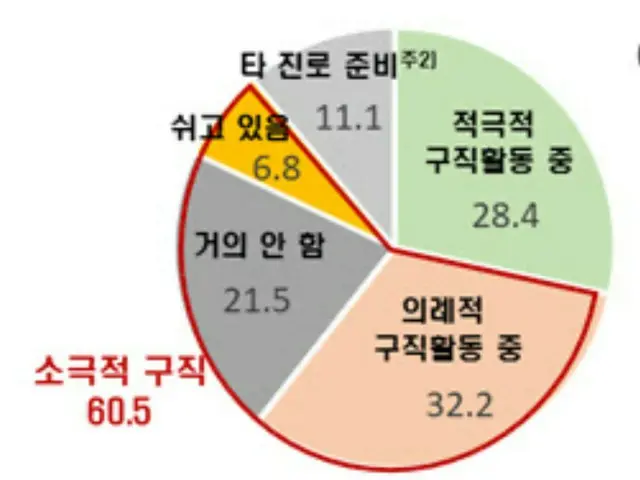
According to the survey, 6 out of 10 fourth-year students or graduates (60.5%) were found to be "passive job seekers" with low expectations of finding a job.
This figure combines those who are just formally looking for work (32.2%), those who are rarely looking for work (21.5%), and those who are taking a break (6.8%).
More than half of the students who responded (51.8%) cited the issue of a lack of jobs as the reason they are not actively looking for work.
Reasons given include: not thinking they would be able to find a job even if they applied (22.0%); a lack of jobs in their field of study or interest (16.2%); and a lack of jobs with appropriate working conditions, including appropriate wages (13.6%).
Additionally, additional preparation due to a lack of one's own abilities, skills, and knowledge (37.5%) was also surveyed as the main reason for not actively seeking work.
Four out of ten university students (37.1%) responded that this year's recruitment market for new graduates is "more difficult than last year." This is a significant increase from last year's survey (3
This is a 0.6 percentage point increase from the previous year (6.5%). Also, the percentage of people who answered "better than last year" was 5.1%, which is an increase from the previous year (3.2%) but still remains at a low level, indicating a lack of confidence in the job market.
This shows that university students continue to have a negative perception of the university. In particular, the average pass rate for document screening for university graduates was 19.4%, which is 2.8 percentage points lower than last year (22.2%).
College students who are actively seeking jobs this year have applied an average of 13.4 times and passed the document screening process an average of 2.6 times.
The order was 1-5 times (40.7%), 6-10th (15.8%), and 25 times (12.0%).
The order of responses was: ▽1 time (25.4%), ▽Failing all times (19.1%), ▽2 times (16.3%).
The survey also found that three in ten university students (32.5%) expect their job preparation period to be more than one year.
As of May this year, the proportion of unemployed young people (aged 20-34) who have been unemployed for more than a year was 55.2%, a figure that has increased by 2.0 percentage points over the past three years.
In a survey, 67.6% of respondents said they expected their time spent in the workforce to be six months or longer. To alleviate the job market difficulties for young people, university students recommended the following: 1) improving the employment environment at companies through deregulation (29.9%); 2) strengthening career guidance and providing on-site training.
They said that it is necessary to eliminate mismatches by expanding support (18.1%) and to expand vocational training opportunities in new industries and new technology fields, such as big data (14.9%).
Lee Sang-ho, head of the Korea Economic and Industrial Cooperation Agency's economic and trade bureau, said, "Amid continuing external uncertainty, including high exchange rates, high prices, and restructuring of the trade order, the domestic labor market is
"The government and the National Assembly should increase corporate vitality through deregulation, tax reform, and investment support, and prevent the possibility of reducing employment for young people by extending the retirement age, etc.
"We need to be careful about certain policies," he said.
2025/12/09 10:10 KST
Copyrights(C) Edaily wowkorea.jp 88